Most approaches to better sleep focus on what happens before bed — winding down, cutting screen time, dimming the lights. But what if there was a way to support your body’s recovery while you’re actually asleep?
That’s the idea behind the Sleep Recovery Taping Workshop, run through Unwind Collective — an extension of the team here at Unwind Chiropractic, created specifically to explore areas like nervous system regulation and body-sleep integration that sit slightly outside traditional chiropractic care.
What the Workshop Is About
The workshop introduces a gentle, non-invasive technique: applying kinesiology tape strategically to the feet before sleep. The idea isn’t to restrict movement or force any kind of correction. It’s to provide subtle, continuous neurological input to the body overnight, the same principle behind kinesiology taping used in sports recovery, just applied to rest instead of activity.
Throughout the session, participants learn:
- How neurological input from kinesiology tape influences the nervous system
- Why the feet (and hands) play such a significant role in balance and nervous system communication
- Simple, practical taping applications focused on relaxation and recovery
- How this approach may support sleep quality and reduce overnight tension
- Practical strategies to bring into your own sleep routine straight away
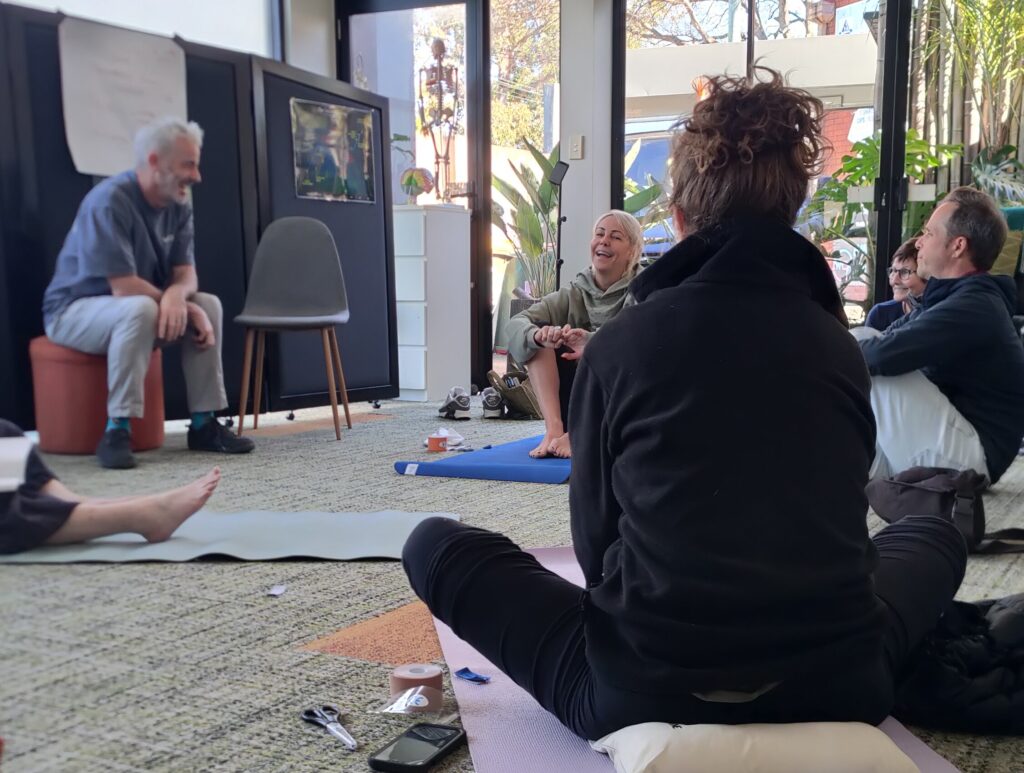
Sessions are small and hands-on, capped at 20 participants, with live demonstrations, guided practice, and plenty of time for questions.
The Science Behind the Sensation
The mechanism taught in the workshop is grounded in real physiology, even if the research on outcomes is still developing.
Your skin is dense with mechanoreceptors — pressure-sensitive nerve endings that constantly report information about position, tension, and movement back to your central nervous system. When kinesiology tape is applied to the skin, it creates a continuous, gentle pulling sensation that keeps feeding signals into this system. Researchers refer to this as increased afferent input, and it’s the same underlying principle used in sports and rehabilitation taping — just applied here to support rest rather than movement or performance.
It’s worth being upfront that the research on kinesiology tape is mixed, particularly around measurable outcomes like joint proprioception. Some studies have found a measurable effect, others haven’t. Where the evidence is more consistent is on the underlying mechanism itself: the tape does reliably stimulate cutaneous receptors and increase sensory input to the nervous system. What that translates to for any individual’s sleep and recovery will vary, which is exactly why the workshop is framed as an exploratory approach worth trying, not a guaranteed fix.
Who It’s For
You don’t need any prior experience with kinesiology taping or a specific health issue to get value from this one. Past participants have included:
- People dealing with physical tension or general restlessness at night
- Athletes and active individuals wanting to improve recovery between sessions
- Anyone interested in nervous system regulation and overall wellbeing
- Simply the curious — people looking for practical, low-effort tools to support better rest
When’s the Next One?
We don’t run this workshop on a fixed schedule — it’s offered periodically, in small groups, rather than as an ongoing weekly class. If the idea of supporting your sleep and recovery through something this simple appeals to you, the best way to stay in the loop is to reach out and ask to be notified when the next session is scheduled.
[Get in touch to hear about the next Sleep Recovery Taping Workshop →]
Further Reading
If you’d like to dig deeper into the research behind proprioceptive taping, these are worth a read:
- Effects of proprioceptive sense-based Kinesio taping on walking imbalance — a clinical study on how taping affects sensory input and movement control.
- Effect of neuromuscular taping on proprioception and postural control: a systematic review — a broader review of the published evidence on this topic.
This workshop is educational in nature and isn’t a substitute for individualised clinical advice. If you have a specific sleep, pain, or health concern, we’d recommend a proper assessment first — get in touch and we can point you in the right direction.
